Microsteps to Syncopa: as easy as uno, dos, tres, cuatro… SYNCOPA! (that’s terrible! sorry!)
I’ve done blog posts on tika-tika and ti-tika but how about syncopated rhythms? As always, I love hearing your suggestions for material – please do share!
In this blog I’ll tell you how I teach syncopa with a lovely little call and response song from Kentucky, USA.
Rhythmic sight reading
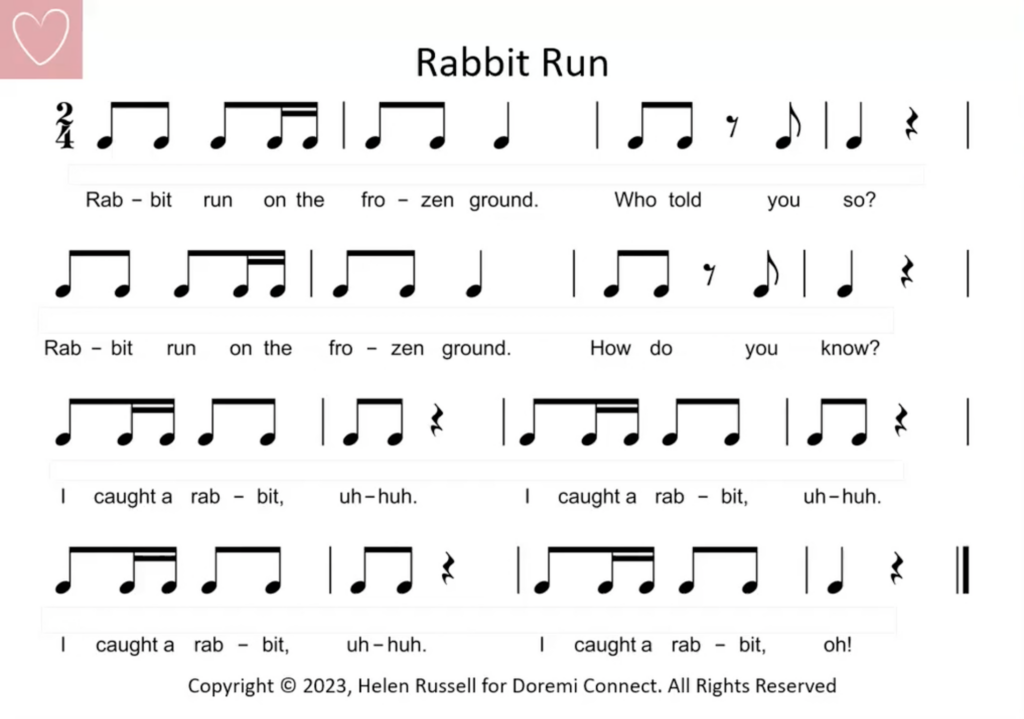
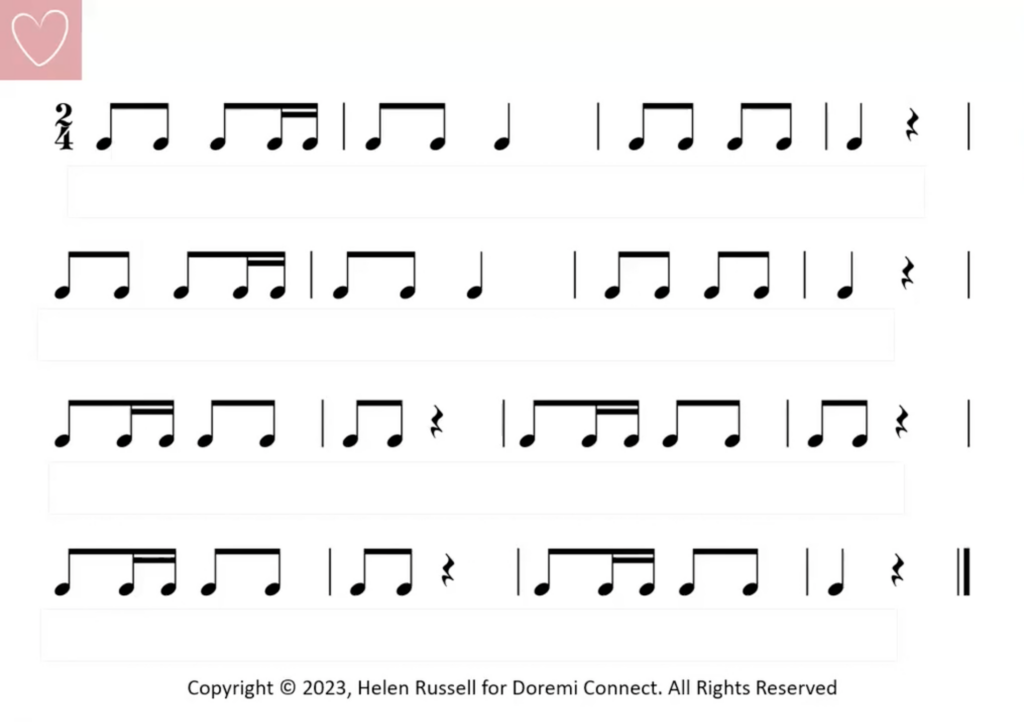
Look at this rhythm:
Have a go at sightreading it by saying the rhythm names.
Spot the difference
You’ve read the rhythm and performed it. Now I’m going to sing some lyrics and I want you to see if there’s anywhere in the lyrics that don’t match the rhythm…
Did you spot it? If you’re not sure, have another listen.
So you don’t see the answer straight away, here’s a nice picture for you to scroll past:
The answer is: there are two places!
Place number 1 is at bar 3
Place number 2 is at bar 3 of the second line (or bar 7)
Listen to the audio clip above again and see if you can hear what is different.
New rhythm
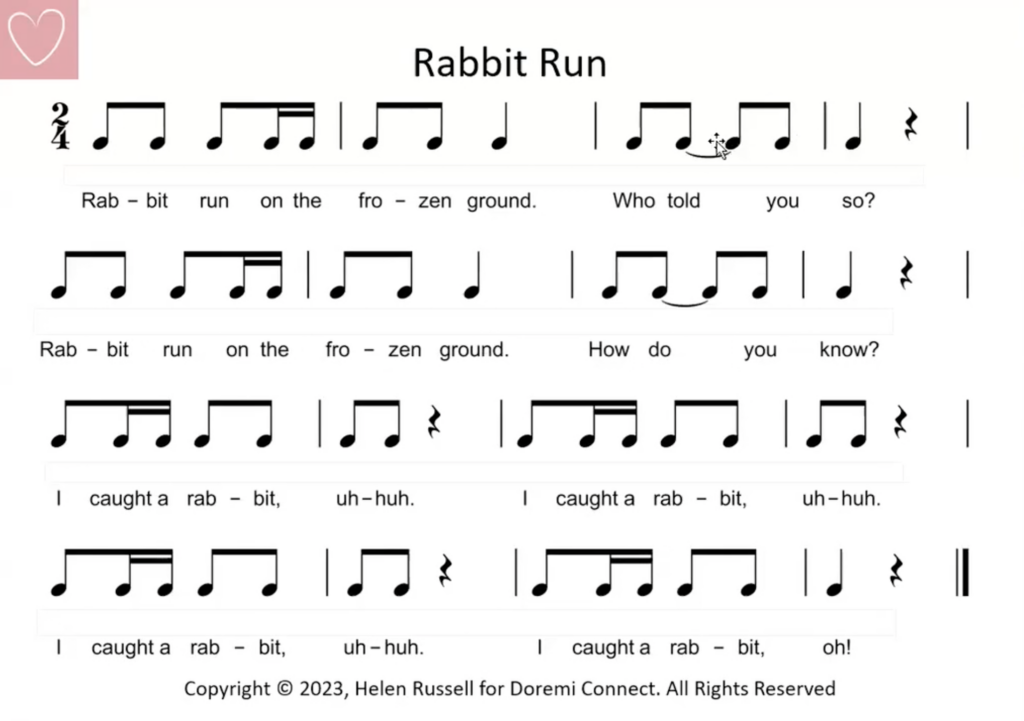
In these two bars that you’ve correctly identified, bar 3 and bar 7, there are less sounds (or syllables) than there are quavers. There are only three sounds in the bar but I’ve drawn 4 quavers. So which quaver is not needed? Which is missing from my lyrics? Quaver number 1, 2, 3 or 4?
Let’s put the lyrics under the notation to find out.
The correct answer is that there’s no syllable or a word at beat 3. So we can put a quaver rest there right?!
But I didn’t rest there! I didn’t take a breath and I held the sound which means I can’t put a quaver rest there. I could tie the note though:
If I tie the second and third quavers, it means we sing the second quaver and hold the sound through to the third quaver.
Let’s sing it again. That works!
Rhythm names…
Let’s sing it with the rhythm names. You’ll probably say:
Titi ti-tika titi ta
Then what?
Ti ta ti? Yep, that works! So, we could replace the tied quaver with a crotchet and make it into a ta. The beamed quavers become single quavers with a flag instead of a beam, like the beam has just flopped down.
Before exploring that further, let’s have a look at the rules for notating rhythm…
Rhythm rules
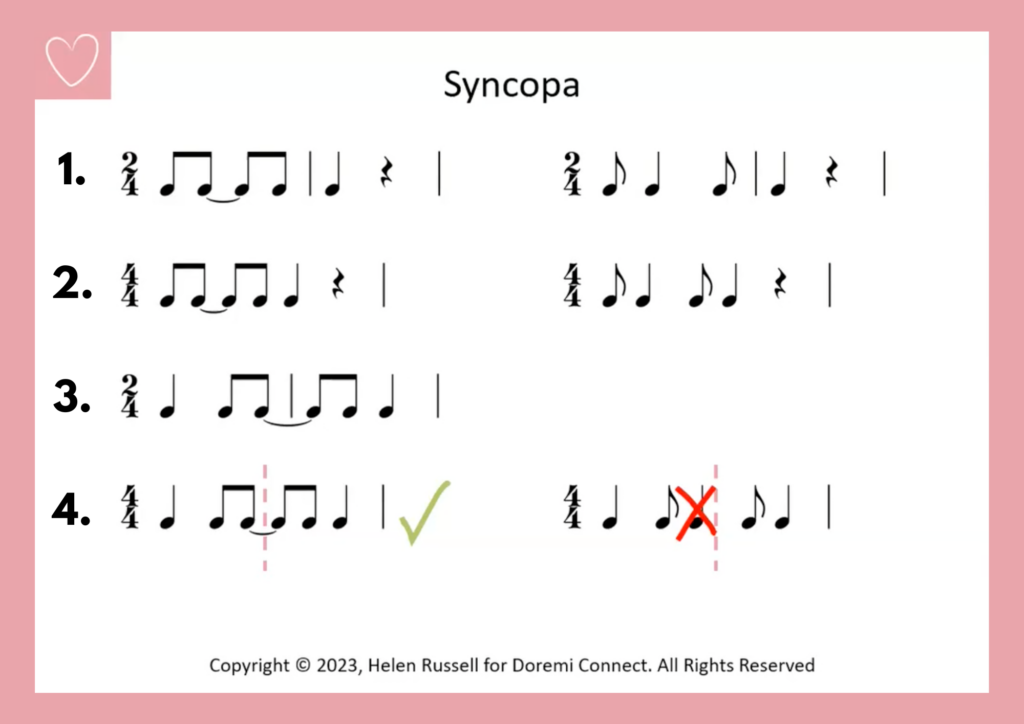
We can only write “ti ta ti”, i.e. quaver crotchet quaver, in certain circumstances. We can’t always replace two tied quavers with a crotchet!
We can do this in the first two examples. If it’s tied across the bar line like in the third example, we can’t replace it with a crotchet so we need to keep the tied note.
If we’re in 4/4, like in the fourth example, we have an imaginary bar line down the middle. The bar is split into two halves and we can’t tie across the invisible mid line in the bar.
Syncopa
There’s another way of saying this rhythm: Syncopa!
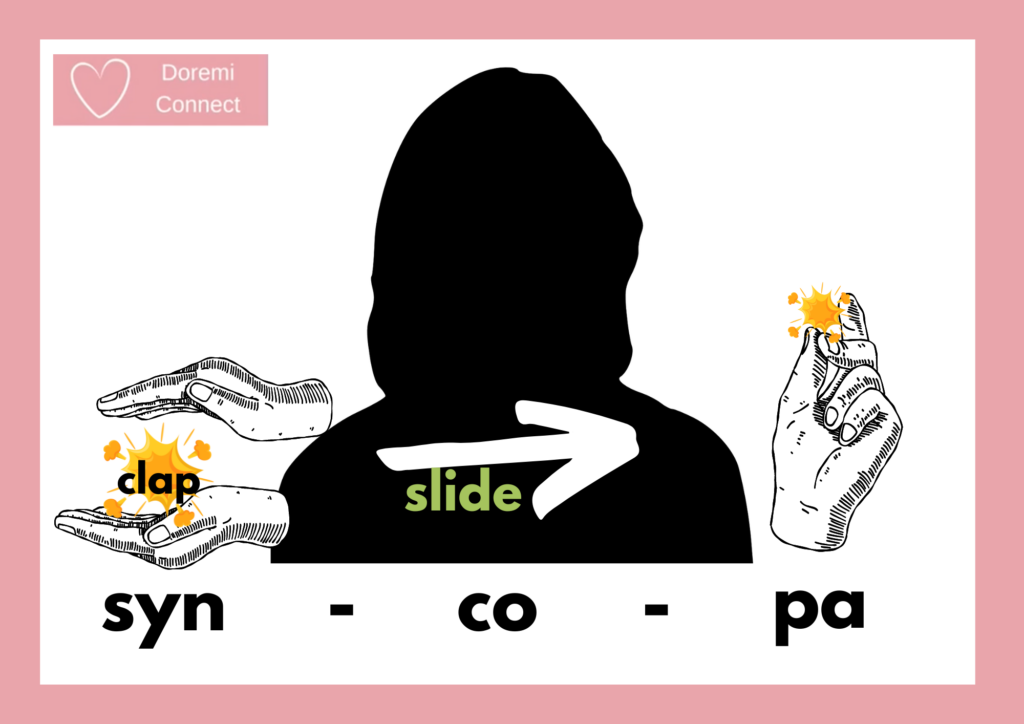
If you’re a fan of body percussion where you do claps for ta, tap legs for titi, shoulders for tikatika, you can do syncopa by a clap to the side, slide one hand across your chest and click. It encourages the long sound in the middle.
Which of the above rhythms do you use syncopa for? I have used it for all of them, even the tied quavers. It’s supposed to be a tool, so if it’s helpful, do it, if it isn’t, don’t do it!
I still use syncopa for the same short-long-short rhythm if it’s semiquaver, quaver, semiquaver because I think it’s such a useful little term.
Try saying the rhythm of Rabbit Run using syncopa. It’s a bit harder to use syncopa if you’re sightreading because if you’re looking at one note at a time, you’ll probably automatically use ti and ta and only as you go along do you realise you could have used syncopa. As you get more practice you’ll be able to read ahead and read in blocks and find it easier to spot.
Now try saying the rhythm with syncopa. If you’ve caught the melody too, sing the melody with the rhythm.
What's next?
Doremi members get access to more ideas for practising complex rhythms and can discuss ideas on our fabulous member forum!
If you’d like to find out more about teaching your students complex rhythms and much more, including over a year’s worth of lesson plans for teaching all the important musical skills with Helen’s clear microsteps, why not try out Doremi Membership for 14 days for just £1?
If you’re a music or piano teacher wanting to use the Kodály approach in your teaching, then my Kodály Treasure Chest is just what you need.
There’s no need to trawl my website looking for hidden treasure! I’ve put all of my best free teaching mini-courses and resources in one place, and I’ll send directions straight to your inbox!
Oops, something went wrong. Please try again.
Yippee! Verify your email from your inbox and we're good to go!